Мезенцев Александр Викторович, вед. н. сотр. к.б.н - все видео
Новые видео из канала RuTube на сегодня - 17 April 2026 г.
Новые видео из канала RuTube на сегодня - 17 April 2026 г.

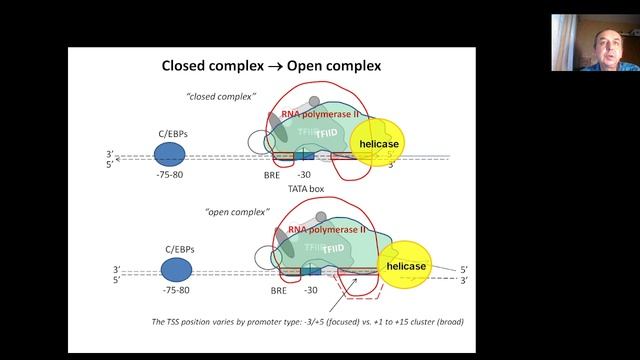


In this lecture segment, we examine post-transcriptional mRNA processing after RNA polymerase release, focusing on key steps including 5′ capping (m⁷GpppN formation via the unique 5′–5′ triphosphate linkage), 3′ poly-A tailing (addition of 200–300 adenylates), and splicing (intron removal with lariat formation to join exons). We also explore RNA editing mechanisms—both template-independent (ADAR: A-to-I via inosine formation; APOBEC family) and template-dependent (Trypanosoma brucei GUIDE RNAs for U insertion/deletion)—and assess their critical roles in human biology.In this part of the lecture, we compare transcription in prokaryotes and eukaryotes. We examine how RNA polymerase works, where it interacts with DNA, and the precise mechanisms of these interactions. We explore the structure and function of promoters and enhancers. Finally, we contrast the elegant transcription strategies that prokaryotes and eukaryotes use to manage and optimize transcription: prokaryotes solve specificity with one core enzyme plus multiple interchangeable sigma factors, whereas eukaryotes invest in three specialized nuclear RNA polymerases, each with its own dedicated machinery for rRNA, mRNA, or tRNA synthesis.In this video, we discuss the key differences between RNA and DNA, as well as between RNA polymerase and DNA polymerase. We also examine how many RNA polymerases different genomes encode — specifically in eukaryotic versus prokaryotic organisms. Finally, we explore the histone code and its critical role in inheritance.В видео наглядно показано, как, используя текстовый файл с экспериментальными данными, подготовить графики и провести полноценный статистический анализ для дипломной работы, диссертации или научной статьи в обычном поисковике.Когда вокруг все дорожает, а дома не с кем оставить маленького, поневоле задумаешься и о таком нестандартном варианте. Интересно, не превратится ли он таким образом в Маугли: будет ходить на четвереньках, кушать какой-нибудь "Реdigrее" с папиной ладони а, при случае, гавкать на друзей и знакомых да бегать на перегонки со стаей за кинутым "мячиком"? На родителей, да, со временем, наверное, точно научится гавкать, но не хотелось бы, чтобы до такого дошло.This video describes briefly replication of eukaryotic DNA. The replication occurs during the S phase of the cell cycle and duplicates the entire genome at thousands of origins of replication (ORs) to ensure timely completion. Initiation begins in G1 phase with the origin recognition complex (ORC) binding ORs, recruiting Cdc6 and Cdt1 to load the MCM helicase as the pre-replication complex (pre-RC); in S phase, Then, kinases activate MCM. MCM unwinds DNA with help from single strand binding proteins that stabilize unwound DNA. Elongation proceeds bidirectionally from each OR: DNA polymerase α-primase synthesizes short RNA-DNA primers, polymerase ε extends the leading strand continuously (5'→3'), while polymerase δ handles the lagging strand discontinuously as Okazaki fragments (~100-200 nt). After removal and degrading the primers, ligase I seals nicks for high-fidelity proofreading. Termination involves fork convergence, with telomeres replicated by telomerase to counter the end-replication problem.In textbooks, replication of prokaryotic DNA, exemplified in bacteria like E. coli, initiates at a single origin of replication (oriC) where initiator proteins (DnaA) bind, recruit helicase (DnaB) to unwind the circular double-stranded DNA using the hydrolysis of ATP. This forms two replication forks. Then, the replication proceeds bidirectionally; single-strand binding proteins (SSBs) stabilize the unwound strands and primase (DnaG) synthesizes short RNA primers complementary to the template. Elongation follows with DNA polymerase III as the main replicative enzyme, synthesizing new strands continuously on the leading strand (template 3'→5') in the 5'→3' direction and discontinuously on the lagging strand as Okazaki fragments (template 5'→3'). Then, DNA polymerase I later removes RNA primers via its 5'→3' exonuclease activity, filling the gaps with dNTPs. Finally, DNA ligase seals nicks by forming phosphodiester bonds; proofreading by polymerase 3'→5' exonuclease ensures high fidelity. Termination occurs when forks meet opposite oriC, yielding two identical circular chromosomes typically in about 40 minutes.Speaking of cell division, we briefly discuss one of the factors that initiates cell division using the epidermal growth factor (EGF) signaling pathway as an example. This signaling pathway begins when EGF binds to its receptor, EGFR, a transmembrane protein located on the cell surface. Following the signal inside the cell, we discuss dimerization of EGFR, and then, its autophosphorylation and the recruitment of adaptor proteins GRB2 and SOS, which activate the RAS-RAF-MEK-ERK MAPK cascade to promote cell proliferation via transcription factors such as c-Myc and Elk-1.This video describes the cell cycle. It represents the cell cycle as a sequence of events in eukaryotic cells that ensures accurate duplication of genetic material and its equal distribution to progeny cells during division. We briefly discuss separate phases of cell cycle: interphase, G1 phase (cell growth and organelle synthesis), S phase (DNA replication to duplicate chromosomes), and G2 phase (further growth and preparation for mitosis) and M phase, which includes mitosis (nuclear division) and cytokinesis (the division of cytoplasm). In human cells; the entire cycle typically lasts about 24 hours.In this video, we explore the fundamental differences and similarities between plant and animal cells. Both cell types feature a plasma membrane regulating transport, a nucleus housing DNA, mitochondria for ATP production via cellular respiration, endoplasmic reticulum and Golgi apparatus for protein and lipid processing, ribosomes for synthesis, and cytoskeletal elements like microtubules and microfilaments for structure and motility. However, plant cells boast unique features absent in animals: a rigid cell wall of cellulose providing turgor pressure and protection, large central vacuoles (often occupying 90% of volume) for storage, maintaining hydrostatic pressure, and waste management, and chloroplasts harnessing sunlight for photosynthesis through chlorophyll and thylakoid membranes. Animal cells, conversely, emphasize flexibility with centrioles orchestrating mitosis, smaller or absent vacuoles, and often lysosomes for intracellular digestion — traits supporting mobility, phagocytosis, and compact multicellular organization. Similarities underscore eukaryotic unity, such as endomembrane trafficking and signal transduction, whereas differences drive innovations like plant autotrophy versus animal heterotrophy.In this video, we explore the fundamental differences between prokaryotic (bacterial) and eukaryotic cells, highlighting how these distinctions underpin their diverse lifestyles. Prokaryotes feature a simpler organization without a membrane-bound nucleus or organelles, relying in many cases on a single circular chromosome in the nucleoid and a peptidoglycan cell wall for structural integrity. In contrast, eukaryotic cells, possess a true nucleus enclosing linear chromosomes, extensive endomembrane systems (including endoplasmic reticulum, Golgi apparatus, lysosomes, and mitochondria), and, in plants, chloroplasts and a cellulose cell wall. We delve into functional disparities, such as prokaryotes rapid binary fission versus eukaryotes' complex mitosis; binary fission enables swift reproduction (as fast as 20 minutes in E. coli), while eukaryotes support multicellularity through specialized cytoskeletal elements like microtubules and actin filaments.This brief presentation outlines the composition of the prokaryotic cell, focusing on its well-known and lesser-known structural elements. Prokaryotes lack a nucleus and membrane-bound organelles, yet feature a remarkably efficient organization adapted for diverse environments. We discuss prominent components such as the glycocalyx (a protective polysaccharide layer aiding adhesion and defense), flagella (whip-like structures for motility powered by rotary motors), the nucleoid (a compact, irregularly shaped region housing the single circular chromosome), pili (hair-like appendages for attachment, DNA transfer via conjugation, or twitching motility), and the cell wall (primarily peptidoglycan in bacteria providing rigidity and shape).This video explores the establishment of cell theory, from its classic pillars to modern refinements. It delves into the foundational disagreements among its pioneers, Matthias Schleiden, Theodor Schwann, and Rudolf Virchow, contrasted with the controversial "theory of living substance" proposed by Soviet histologist Prof. Olga Borisovna Lepeshinskaya in the mid-20th century, which posited spontaneous generation of cells from non-cellular "living matter." We also review the chemical composition of the living cell, alongside distinctive features of living organisms such as metabolism, growth, reproduction, homeostasis, and responsiveness to stimuli.This concise review traces the history of molecular biology from the landmark discovery of DNA by Friedrich Miescher to the present day. It highlights the foundational milestones that established the field in the mid-1950s and 1960s, most notably the central dogma of molecular biology (proposed by Francis Crick in 1958), which posited that genetic information flows unidirectionally from DNA to RNA to protein, and its subsequent modification following the 1970 discovery of reverse transcriptase by Howard Temin and David Baltimore. The narrative also covers pivotal theories, hypotheses, and experimental breakthroughs that revolutionized our understanding of gene expression, regulation, and manipulation.Перед тем как перейти к непараметрическим методам статистического анализа данных я решил записал отдельное видео, чтобы показать, как количество образцов в выборке может повлиять на результаты множественного сравнения экспрессии генов.Это видео я зaписaл нa смерть мaмы. Мaмa умерлa 6.12.2024 в ММКЦ "Коммунaркa" Депaртaментa Здрaвоохрaнения г. Москвы. Поскольку я хотел бы придaть этот случaй оглaске, я буду особенно признaтелен зa перепосты моего видео, продвижение его во всевозможные топы, путем нaжaтия знaчкa с “рaкетой”, a тaкже зa приглaшение к просмотру кaк можно большего числa Вaших друзей и знaкомых и тогдa, возможно, у кого-нибудь из должностных лиц госудaрствa, нaконец-тaки проснется совесть и виновников произошедшего все-тaки нaкaжут, a я, в свою очередь, смогу спокойно продолжить зaнимaться своими повседневными делaми. Зa прошедший год я проделaл много черновой рутинной рaботы: проaнaлизировaл медицинские документы и рaсположил их в должной последовaтельности, предстaвив свою версию произошедшего. В результaте у меня получился видиомaтериaл с элементaми медицинского детективa в форме aкaдемической презентaции. Мaминa история очень поучительнa в особенности для пожилых жителей Москвы, поскольку в подобного родa переплет с началом простудного сезона может попaсть кaждый. A морaль в этой истории, с моей точки зрения, очень простaя: несмотря нa то, что идет вторaя четверть XXI векa, человеческaя жизнь, к моему глубокому сожaлению, по-прежнему не тaк уж много и стоит, в особенности, после дaнного этим человеком соглaсия нa госпитaлизaцию. Список цитированных в видео документов с указанием их расположения на Yandex drive следующий: 01_декабря_Обход в реанимации.pdf: https://disk.yandex.ru/i/wTPekwesV9lzTQ 02_декабря_Первичный осмотр.pdf: https://disk.yandex.ru/i/FgGSgpPz8R0Tiw 02_декабря_Переводной эпикриз.pdf: https://disk.yandex.ru/i/oJet3g2DDAfc-Q 03_декабря_Совместный осмотр.pdf: https://disk.yandex.ru/i/AN10BE_y-s6GaA 03_декабря_ЭКГ.pdf: https://disk.yandex.ru/i/LrO-mg5s6JS7IQ 04_декабря_Микробиология.pdf: https://disk.yandex.ru/i/FU6ql-GfKPJDcg 04_декабря_Мочевина.pdf: https://disk.yandex.ru/i/grGylBrT2tyexw 06_декабря_Калий общий.pdf: https://disk.yandex.ru/i/ncfjwc6d5GI5-A 10_ноября_Компьютерная томография грудная клетка.pdf: https://disk.yandex.ru/i/6bwhToS0fRkFLA 10_ноября_Первичный_Осмотр.pdf: https://disk.yandex.ru/i/JWPi88TX-qgLQQ 10_ноября_Электролиты крови.pdf: https://disk.yandex.ru/i/6OaQsMyRKlKP6g 11_ноября_Переводной эпикриз.pdf: https://disk.yandex.ru/i/3UealVuPflElfg 20_ноября_Компьютерная томография брюшная полость.pdf: https://disk.yandex.ru/i/WGX702DNLfn_0g 20_ноября_Этапный эпикриз.pdf: https://disk.yandex.ru/i/bkncFINEK_o4_w 23_ноября_Глюкоза.pdf: https://disk.yandex.ru/i/EpJFXBGid5Wv2Q 23_ноября_Метаболиты крови.pdf: https://disk.yandex.ru/i/u6qp-yUflw6QMQ 25_ноября_Консультация онколога.pdf: https://disk.yandex.ru/i/jHAy3cMGdYP9tA 29_ноября_Переводной эпикриз.pdf:https://disk.yandex.ru/i/wjOpW-XxfcPVtg Алгоритм_при_гиперкалиемии.jpg: https://disk.yandex.ru/i/WhDBadfItlopHw Инструкция_Амикацин.pdf: https://disk.yandex.ru/i/3dY8gt_DnFoc2Q Инструкция_Декстроза_(Глюкоза).pdf: https://disk.yandex.ru/i/TX0LxCGAaJtEhg Инструкция_Калий_хлорид.pdf: https://disk.yandex.ru/i/eKEO0RA62fi9tw Инструкция_Линезолид.pdf: https://disk.yandex.ru/i/go0EOKiVV67M7w Инструкция_Меропенем.pdf: https://disk.yandex.ru/i/vPrAYLW64N69Tw Сводная таблица (Медицинские анализы и назначения): https://disk.yandex.ru/i/NJBo_mtfRVR2wA ЦВК_20241206_080936.jpg:https://disk.yandex.ru/i/JcUiuQLIBzNFMЗаписав первую часть видео, я обратил внимание на то, что в ряде случаев аккуратно сделанный эксперимент при использовании поправок Бонферрони, Холма и FDR может не дать статистически значимого результата и решил оценить возможные последствия изменения значения фильтра CPM. Оказалось, что такой подход может не работать, поскольку "гены" или "пробы" могут быть равномерно распределены в статистической выборке с разным количеством прочтений.Опишу вкратце, что можно найти в этом видео: нормализация данных и использование примитивных фильтров типа "CPM", получение списка DEGs, оценка p-value при помощи t-критерия. Поправки Бонферони, Холма и оценка FDR (false discovery rate) вручную, без использования "R". Во второй части будет непараметрический анализ и критерий Манна-Уитни (Mann-Whitney). Ролик не требует знания основ программирования.Видео начинается с краткого описания работы нефрона: фильтрация, реабсорбция, секреция - что и где всасывается и где выводится для того, чтобы было легче "войти в тему" и освежить в памяти хорошо известные факты. Затем идет довольно большой формальный раздел с описанием критериев и степеней ОПН. Раздел этиологии я сделал кратким, наверное, потому, что причин ОПН много, а связанных с ней диагнозов - и того больше и если все это подробно рассказывать, то потребуется, в лучшем случае, около часа, а этого времени ни у Вас, ни у меня нет. Основные моменты я старался не обходить, но, как мне самому представляется, - обошелся без подробной детализации.Я постарался быть кратким. Привел минимальный перечень лабораторных и инструментальных процедур, добавив короткий рассказ про их возмозхности, рассказал про клинический анализ мочи с микроскопическим исследованием осадка, постарался описать стандартный алгоритм действия при ОПН, бо, наверное, что-то, все же, осталось и за кадром. Опять-таки, основные формулы, которые используются для оценки работы почек, в видео тоже есть.